Why “Interstitial Journaling” Might Save Your Sanity
This is totally ‘borrowed’ from Rachelle in Theory’s newsletter. The newsletter doesn’t seem to have an online archive, so I’m reposting the content here, because I wanted to share it.
Please go subscribe to both the newsletter, and Rachelle’s YouTube channel.
In the middle of my workday yesterday, I picked up my phone. I had just remembered to text my partner about our dinner plans. Forty-five minutes later, I was still on my phone, deep in a Reddit thread about mechanical keyboards without any dinner plans to show for it.
(I don’t even have a passion for mechanical keyboards. And I certainly don’t need one that matches my mouse and headphones. Right?)
At that point, I realized I had fallen into what is fondly known as the Bermuda Triangle of Productivity.
The Bermuda Triangle of Productivity was a term popularized in the early days of social media to describe the time you lose to the internet when you’re trying to be productive. You let your attention slip for one second and, bam, you’re in a fog that you can’t seem to navigate out of.
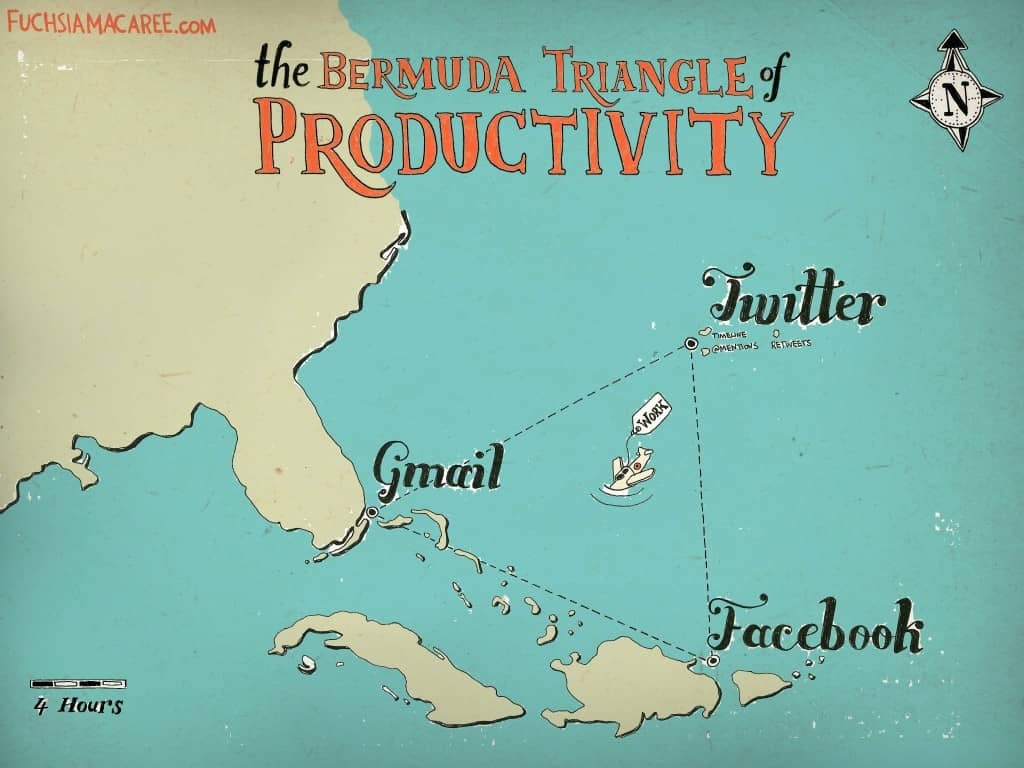
Those of us with short attention spans are familiar with the Bermuda Triangle of Productivity, and very familiar with just how hard it is to escape. Our distractions hold our attention more easily than our priorities, and letting them go is both effortful and shameful. We were supposed to be focusing. What is wrong with us?
Luckily, others have charted these waters before us. We have an easy-to-implement solution to getting ourselves back on track. It’s a practice called Interstitial Journaling.
The word “interstitial” just means “in between”. Instead of tracking your work with a static to-do list, you track your workflow with real-time journal entries as you switch tasks or get distracted throughout the day.
How to Journal, Interstitially
Every time you take a break, switch tasks, or otherwise realize you’re lost at sea, open your notebook and jot down three things:
- The Time: Timestamping roots you in time and space. Whether we’re in deep flow or lost at sea, noting the time connects us with its passage. This is game-changing if you struggle to control your attention or experience time-blindness. Not only can you see how long tasks or distractions take, but you get a better sense of how much time you still have left, so you can plan accordingly going forward.
- The Behavior: Write a few words about what you just did and how it made you feel. It might be that you were focused and finished what you were supposed to be working on, and you feel great. Or it might be that you just spent 50 straight minutes playing Cupcake 2048, and you feel totally dazed (and a little hungry). Either way, this practice provides instant feedback, which keeps you aware of the real-time effects of your behavior.
- The Next Task: Now, beneath your behavior, write the thing you’ll work on next. If you’re stuck in the Bermuda Triangle, this is the part where you reroute. Writing it down helps us commit to a specific direction, and reminds us that getting lost isn’t the end of the world. You can actually come back from it, and you will.
It’s important during this whole practice to focus on simply witnessing yourself. Don’t judge, don’t deliberate; write honestly and kindly. That awareness alone is often enough to kill the procrastination loop and pull you back into the present moment.
By making your transitions intentional, you stop losing your days to the fog and start reclaiming your mind, one interstice at a time.
From Theory to Practice
This week, try keeping a blank page open on your desk. It can be a single sheet of paper, or a page in your notebook — even a 24-hour weekly would work.
Every single time you switch tasks, get distracted, or feel the urge to check your phone, write the time and exactly what is happening.
Then, at the end of the week, give it a once-over for any patterns. Were there certain tasks you routinely found boring enough to switch out of? How can you make those more engaging? What about work interruptions? Could you set heads-down time on Slack to avoid losing focus?
At the end of it all, you’ll be left with a compassionate set of data that will help you chart new courses in the future.